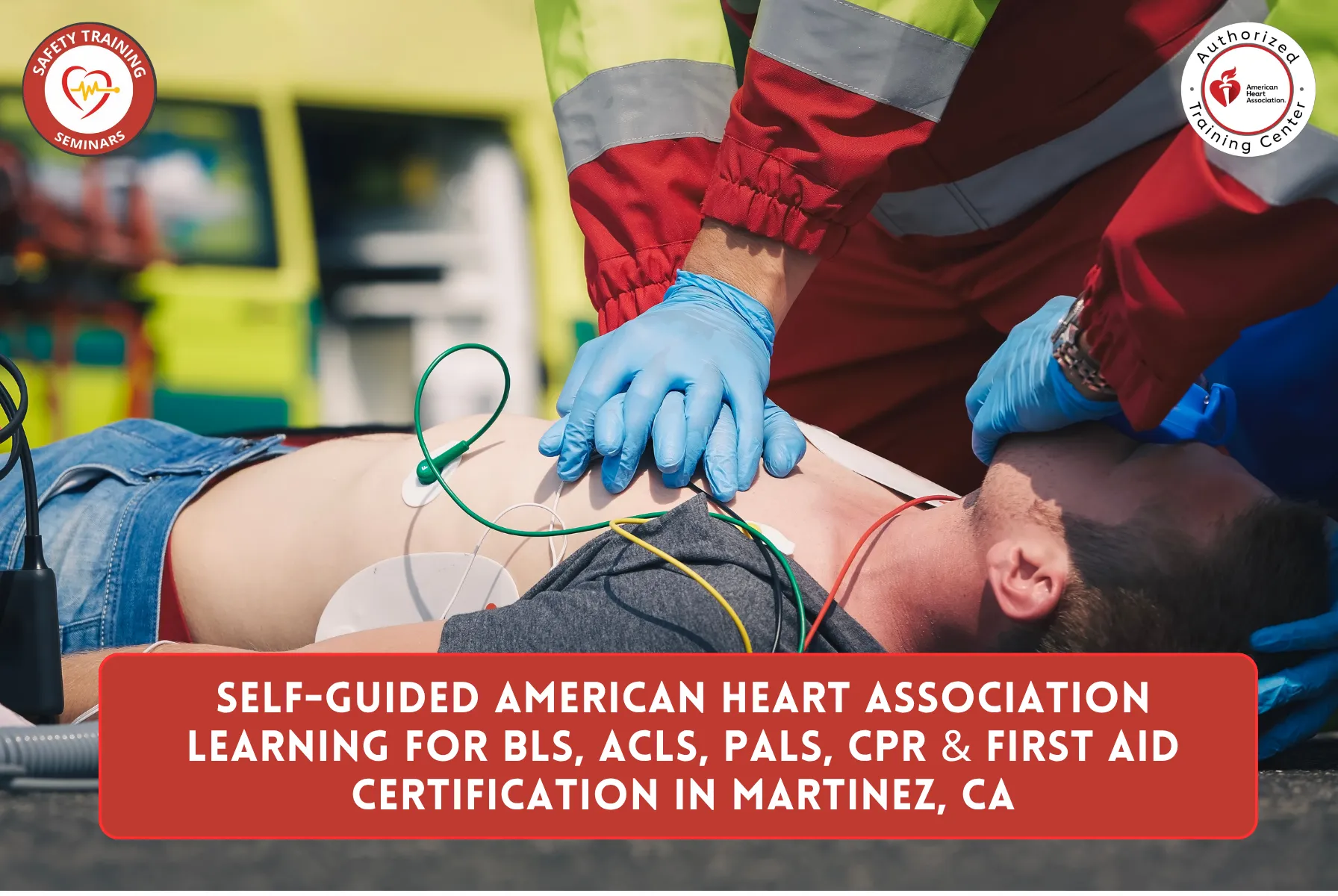
Healthcare students at local community colleges, clinical professionals commuting along the Highway 4 corridor, and local school staff members often face the same challenge: finding time for required life safety certifications. Balancing long shifts, clinical rotations, or classroom teaching with rigid, multi-hour lectures can be difficult. American Heart Association (AHA) Self-Guided Learning offers an adaptable alternative, combining online cognitive coursework with structured hands-on skills verification. Whether you need Basic Life Support (BLS), Advanced Cardiovascular Life Support (ACLS), Pediatric Advanced Life Support (PALS), or general Heartsaver CPR and First Aid, this hybrid format allows you to complete the classroom portion on your own schedule before completing the practical skills evaluation in person.
Key Takeaway: AHA Self-Guided Learning lets learners complete their theoretical coursework online at their own pace while still fulfilling the essential hands-on skills requirements needed for an official AHA course completion eCard. Because certification requirements vary by role, always confirm your employer’s or academic institution’s specific training standards before enrolling.
What Is American Heart Association Self-Guided Learning?
AHA Self-Guided Learning (often referred to as blended learning or HeartCode® for healthcare disciplines) divides the training process into two distinct components: independent cognitive study and an in-person physical skills session.
Unlike completely unaccredited internet courses that omit hands-on practice, this AHA-approved format preserves the clinical rigor of traditional instruction while providing temporal flexibility.
[Phase 1: Online Cognitive Module] ──> [Phase 2: Hands-On Skills Evaluation] ──> [Phase 3: Official AHA eCard Issued]
- Cognitive Coursework: You register for the official online learning module, working through interactive scenarios, patient simulations, and video tutorials at your own pace.
- Individual Preparation: You can pause, review, and revisit complex algorithms—such as pediatric resuscitation sequences or cardiac arrest pathways—until you feel completely confident in the material.
- Hands-On Skills Verification: Once you pass the online cognitive portion, you attend a scheduled, in-person skills session. A qualified instructor assesses your chest compression depth, ventilation technique, AED operation, or advanced airway management.
- Documentation: After successful completion of both the online coursework and the hands-on evaluation, you receive an official AHA course completion eCard.
AHA Self-Guided Learning Options Available in Martinez
Different professions require different levels of emergency cardiovascular care training. The AHA Self-Guided Learning format applies across several core disciplines, allowing Contra Costa County learners to tailor their training to their specific scope of practice.
Basic Life Support (BLS)
The BLS program focuses on high-quality cardiopulmonary resuscitation for adult, child, and infant victims, as well as multi-rescuer team dynamics, AED utilization, and foreign-body airway obstruction relief.
- Primary Audience: Registered nurses, medical assistants, dental hygienists, emergency medical technicians, paramedics, radiologic technologists, nursing students, and physician assistants.
- Format Benefit: Healthcare workers can review resuscitation science independently and then demonstrate high-quality compressions and bag-valve-mask (BVM) ventilation during a rapid in-person skills assessment.
Advanced Cardiovascular Life Support (ACLS)
ACLS expands upon foundational BLS skills to cover advanced interventions during adult dysrhythmias, acute coronary syndromes, stroke, and cardiac arrest.
- Primary Audience: Intensive care nurses, emergency room staff, hospitalists, cardiologists, surgical teams, and advanced practice providers.
- Format Benefit: Experienced clinical providers can navigate complex ECG interpretation, pharmacology, and resuscitation team dynamics online, shortening the required time spent in physical training centers.
Pediatric Advanced Life Support (PALS)
PALS targets the systematic evaluation and treatment of pediatric respiratory emergencies, shock, and cardiac arrhythmias.
- Primary Audience: Pediatric nurses, emergency department staff, pediatricians, pediatric dental specialists, and respiratory therapists.
- Format Benefit: Clinicians focus on pediatric drug dosages and age-specific resuscitation algorithms online, reinforcing their critical decision-making prior to practical skills testing.
Heartsaver CPR, AED, and First Aid
Heartsaver courses focus on general lifesaving skills for non-healthcare professionals. Topics include treating medical, injury, and environmental emergencies, administering chest compressions, utilizing an AED, and helping choking victims.
- Primary Audience: Educators, childcare providers, youth sports coaches, construction safety officers, industrial facility staff, and community members.
- Format Benefit: Individuals can study basic first aid concepts and cardiac response at home, keeping physical skills practice brief and straightforward.
How to Determine Which AHA Course You Require
Selecting the correct training path is essential. Enrolling in a general CPR class when your facility requires a healthcare-level BLS credential can cause delays in employment onboarding or clinical placement.
| Course | Primary Target Audience | Core Focus Areas |
| BLS | Healthcare professionals, allied health workers, clinical students | High-quality CPR, AED use, team dynamics, BVM ventilation |
| ACLS | Adult critical care, emergency, and surgical personnel | Advanced airway management, ECG interpretation, pharmacology, code leadership |
| PALS | Pediatric critical care, emergency, and pediatric clinic personnel | Pediatric assessment, respiratory failure, shock management, pediatric arrhythmias |
| CPR / AED | Workplace personnel, fitness directors, coaches, general public | Adult/child CPR, choking relief, automated external defibrillator operation |
| First Aid | General employees, industrial workers, childcare providers | Hemorrhage control, burn care, fracture stabilization, sudden illness response |
Note: Always double-check your licensing board, school program, or clinical department guidelines to ensure you select the appropriate course code.
Comparing Training Formats: Self-Guided vs. Traditional vs. Online-Only
Understanding how training delivery methods differ ensures you fulfill your regulatory and professional requirements without sacrificing convenience.
- AHA Self-Guided (Blended) Learning: Combines remote cognitive learning with an indispensable in-person skills evaluation. It satisfies OSHA, Title 22, Joint Commission, and healthcare facility standards because dynamic physical performance is verified by an instructor or calibrated feedback system.
- Traditional Instructor-Led Training: Involves sitting through a fully scheduled, multi-hour classroom presentation with group discussions, live lecture delivery, and immediate hands-on practice. Ideal for individuals who prefer structured group interactions or are taking a course for the first time.
- Unaccredited “Online-Only” Programs: These web pages promise instant certifications without requiring any physical hands-on skills practice. Warning: Most healthcare employers, hospitals, nursing schools, and state licensing boards explicitly reject online-only certifications because physical competency cannot be evaluated over a screen.
Completing Your Training in Martinez, CA
Located along the Carquinez Strait, Martinez serves as a central hub connecting northern Contra Costa County, the refinery corridor, and nearby communities like Concord, Pleasant Hill, Benicia, and Pacheco. Professionals residing or working in the area often balance demanding shifts across regional healthcare centers, local government offices, and industrial facilities.
For nursing candidates attending nearby institutions, teachers serving regional school districts, or clinical staff working in medical facilities along Arnold Drive and Alhambra Avenue, taking a traditional four-hour weekday class isn’t always practical. AHA Self-Guided Learning fills this gap, allowing local learners to complete coursework late at night or between shifts, keeping their local travel focused strictly on the brief hands-on verification appointment.
Local Training with Safety Training Seminars
For learners seeking a streamlined local skills verification, Safety Training Seminars provides official AHA courses designed around flexible schedules. Conveniently situated near downtown and major transit arteries, the local facility allows students to complete their practical skills assessments quickly and efficiently.
Safety Training Seminars Martinez CPR Training Center Address:
535 Main Street, Suite 307, Martinez, CA 94553
You can review specific scheduling options, explore available dates, and enroll directly through their dedicated BLS and CPR classes in Martinez resource page. If your professional development or workplace licensing requires advanced cardiovascular or pediatric credentials, view available scheduling through their local ACLS and PALS training options portal.
Frequently Asked Questions
Is an AHA Self-Guided BLS eCard identical to a traditional classroom eCard?
Yes. Upon successful completion of both the web-based cognitive portion and the in-person skills evaluation, you receive the standard American Heart Association BLS Provider eCard. The certification carries the exact same recognition among healthcare facilities, universities, and credentialing boards as a traditional classroom card.
Can I complete my First Aid and CPR skills evaluation in Martinez if I live in Benicia or Concord?
Yes. Commuters traveling from nearby areas such as Benicia, Concord, Pleasant Hill, or Pacheco can easily schedule their skills evaluation at the Martinez facility. As long as you complete the official online AHA module beforehand, your hands-on verification can be completed at any authorized location.
How long does the in-person skills practice and testing session take?
While the online portion can take anywhere from 1 to 4 hours depending on the subject (BLS, ACLS, or Heartsaver), the in-person skills verification is typically very efficient. Because you have already mastered the theoretical concepts online, the physical evaluation usually takes approximately 30 to 45 minutes.
Will my healthcare employer accept an online-only CPR card without a hands-on test?
In almost all cases, no. Major hospital systems, nursing programs, and medical organizations require verified hands-on demonstration of CPR compressions and ventilations. Unaccredited online-only cards lack physical testing components and are regularly turned down during clinical onboarding or employment verification.
How far in advance do I need to finish the online AHA module before attending my skills test?
You must finish all online learning modules and print or download your official AHA completion certificate prior to arriving for your physical assessment. Instructors must verify that the cognitive coursework is finished before conducting the hands-on skills evaluation.
Next Steps for Your Certification
AHA Self-Guided Learning offers an efficient, scientifically rigorous path to obtaining or renewing your resuscitation credentials without locking you into long classroom sessions. By separating independent cognitive study from physical skill mastery, you retain complete control over your learning schedule while fulfilling mandatory professional requirements.
Before registering, verify with your supervisor, school program coordinator, or state licensing board to determine whether BLS, ACLS, PALS, or Heartsaver CPR/First Aid is required for your role. Once confirmed, complete your online study modules and schedule your hands-on assessment at a local training center to secure your official course completion card.